


 SaintTreyW
Jan 19
6 mins read
SaintTreyW
Jan 19
6 mins read
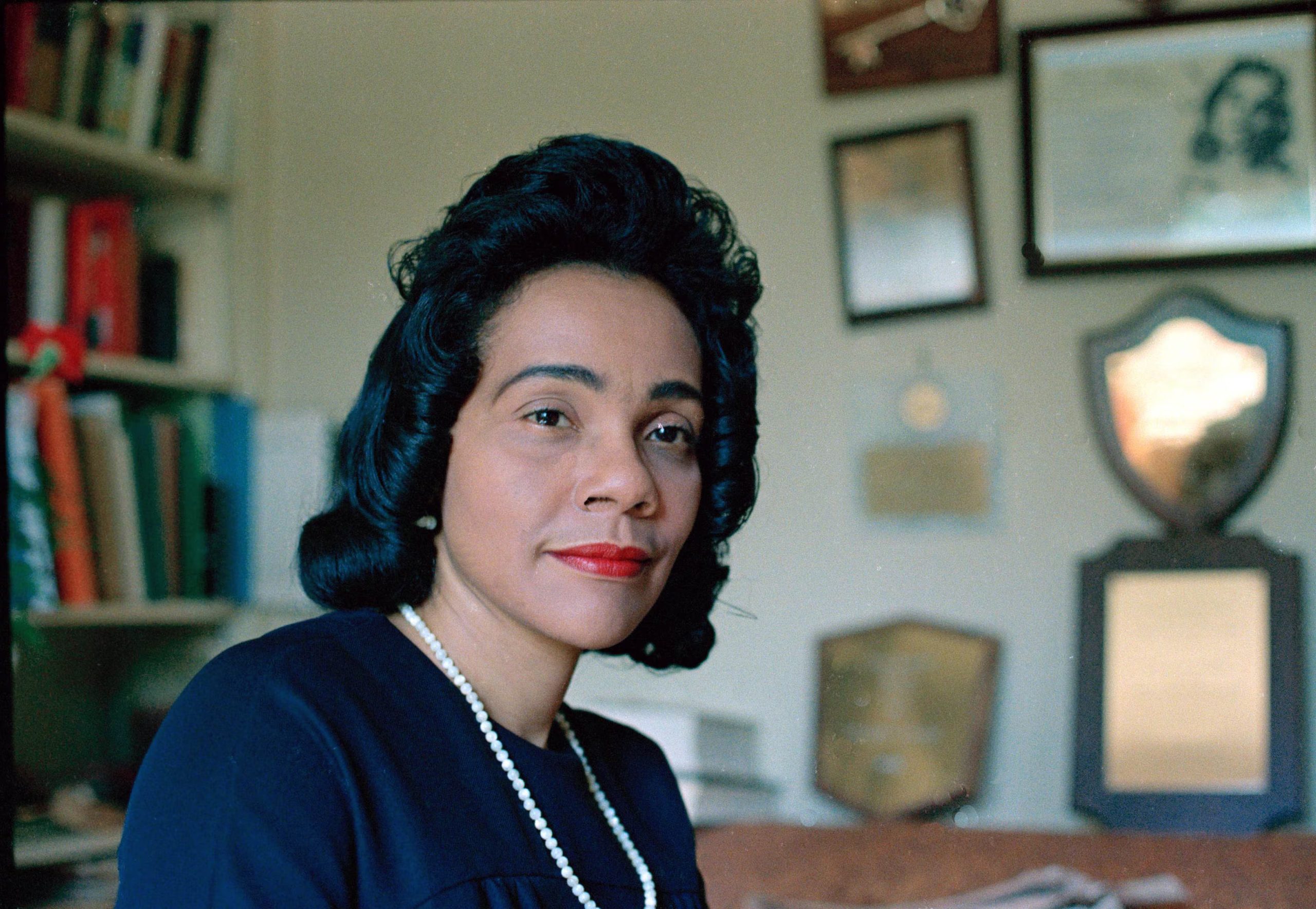
For decades, Coretta Scott King has been remembered politely, selectively, and incompletely. She appears more often in photographs than in audio. She is framed as elegant rather than outspoken, supportive rather than strategic, a widow rather than a political actor in her own right. History has been more comfortable styling her as an accessory to greatness than reckoning with the substance of her convictions. But to understand the modern fight for LGBTQ equality without acknowledging Coretta Scott King is to misunderstand both movements entirely.
Long before gay rights became a cause politicians were willing to publicly touch, King made a clear and consistent case that the struggle for racial justice and the struggle for gay liberation were inseparable. She did so not quietly, not accidentally, and not in contradiction to her husband’s legacy, but by extending it with precision and courage.
Coretta Scott King did not discover activism through marriage. As biographer Clayborne Carson has noted, she was more politically active than Martin Luther King Jr. when they met. As a college student, she was already involved in the NAACP and campus race relations committees. In early letters, King wrote that one of his first attractions to Coretta was her political mind. He understood their relationship as a partnership, even if the movement rarely allowed it to function as one.

That imbalance followed her into history. At the 1963 March on Washington, Coretta Scott King sat silently in the second row. According to Smithsonian oral histories, she was mentioned only once that day, despite a lifetime of organizing and analysis behind her. Like Ella Baker, Diane Nash, and Fannie Lou Hamer, she was essential to the movement and marginalized within its public memory. The expectation was that women would labor in the shadows while men stood at the microphone.
That arrangement ended on April 4, 1968.
Four days after her husband was assassinated in Memphis, Coretta Scott King returned to the city where he was killed and led more than 50,000 mourners and workers through the streets in a memorial march. Wearing a black lace headscarf, she reportedly said, “I need to go finish his work.” Her resolve was not symbolic; it was operational.
Within weeks, she delivered her husband’s planned anti-Vietnam War speech in Central Park. Two months later, she led the Poor People’s Campaign to Washington, carrying forward King’s demand that the nation confront poverty as a moral crisis. Her analysis emphasized intersections of race, class, and gender that had often been minimized in public discourse. This was not preservation; it was expansion.
That same instinct guided her later advocacy for LGBTQ Americans.
In 1983, on the 20th anniversary of the March on Washington, Coretta Scott King publicly endorsed the federal Gay and Civil Rights Act, which would have banned discrimination against gay and lesbian people in housing, employment, and public accommodations. At the time, this position was politically radioactive, especially for a Black woman associated so closely with the most revered figure in American civil rights history.
King did not hedge.
She reminded critics that many gay men and lesbians had been integral to the civil rights movement, including Bayard Rustin, the openly gay strategist who organized the 1963 march itself. If gay people had risked their lives for racial justice when few defended them, she argued, the moral obligation to stand with them was obvious.
That same year, she intentionally made space for Black lesbian poet Audre Lorde at the anniversary rally. Lorde’s remarks explicitly joined the Black freedom struggle to the gay rights movement, declaring that freedom could not be rationed. King did not distance herself from this framing. She amplified it.
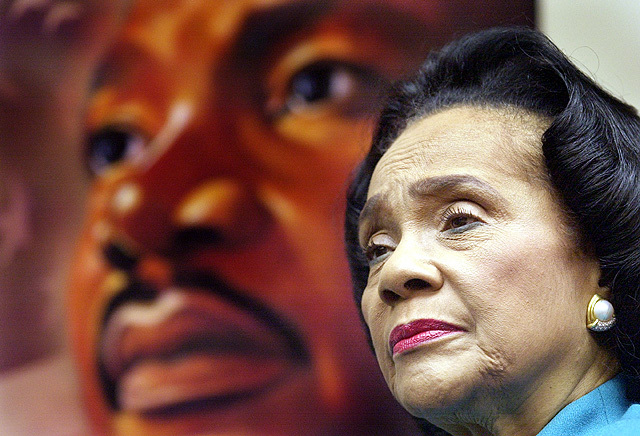
When HIV/AIDS ravaged queer communities in the 1980s, and the federal government remained silent, Coretta Scott King again acted. With the help of her openly gay assistant Lynn Cothren, she ensured that the King Center became a welcoming space for LGBTQ people, particularly Black queer people, many of whom were grieving, organizing, and dying in isolation. After the death of a close friend, she hosted a memorial and encouraged participants to sew a panel for the AIDS Memorial Quilt. At a time when stigma dictated silence, she chose visibility.
Her advocacy did not slow.
In 1986, after the Supreme Court upheld state sodomy laws in Bowers v. Hardwick, King spoke at the Human Rights Campaign Fund’s New York gala. In 1993, she urged President Bill Clinton to lift the ban on gay people serving openly in the military. In 1994, she stood alongside Sen. Ted Kennedy and Rep. Barney Frank to support the Employment Non-Discrimination Act, grounding her position in the belief that justice could not be parceled out for political convenience.
In 1996, Coretta Scott King brought that conviction directly to Atlanta Pride, becoming one of the most prominent civil rights leaders to ever address the city’s annual celebration. Speaking in her hometown, at a moment when LGBTQ people were still widely marginalized by law and culture, King framed Pride not as a fringe gathering but as part of the nation’s unfinished civil rights project.
Her presence alone carried weight, but her message was unmistakable; the movement for Black freedom and the movement for gay rights were bound together by shared struggles against discrimination, state violence, and moral exclusion. At a time when many public figures avoided Pride events out of political caution, King’s appearance signaled that LGBTQ dignity was not a separate issue but a core test of American democracy and the values her husband had died advancing.
In 1998, speaking at a Lambda Legal Defense and Education Fund luncheon, King addressed resistance within Black communities directly. “I still hear people say that I should not be talking about the rights of lesbian and gay people and I should stick to the issue of racial justice,” she said. She then cited her husband’s most enduring moral claim, “Injustice anywhere is a threat to justice everywhere.” Her appeal was not rhetorical; it was corrective.
The following day in Chicago, she stated plainly that homophobia functions like racism and antisemitism, dehumanizing entire groups and laying the groundwork for further violence. She rejected the false hierarchy of oppression that conservative religious groups attempted to impose, particularly those who insisted that comparing racial justice to gay rights was offensive or illegitimate.
King understood those attacks clearly. She named them as fear, not theology.
She returned to these arguments again and again, including during the early 2000s debates over same-sex marriage. In 2004, when President George W. Bush supported a constitutional amendment banning same-sex marriage, Coretta Scott King called the proposal “gay bashing.” Even as some of her own children publicly distanced themselves from that position, she did not retreat.
By then, the pattern was unmistakable. For more than two decades, she had used the moral authority of the King legacy not to narrow its application but to widen it. She insisted that civil rights, if they were to mean anything, had to include sexual orientation as a fundamental human rights concern.
She understood how she was remembered and chose to disrupt it. “I am made to sound like an attachment to a vacuum cleaner,” she once said, referring to the way history reduced her to wife and widow. “But I was never just a wife, nor a widow. I was always more than a label.”
That refusal matters now.
In an era where Dr. King’s words are regularly stripped of their radicalism and weaponized against the very movements they were meant to inspire, Coretta Scott King offers a different model. She did not freeze her husband’s legacy in amber. She tested it against new injustices and demanded consistency.
She fought for gay rights not in spite of Martin Luther King Jr., but because she took him seriously.
The most honest way to honor his memory is to honor hers, to recognize that the work did not end in 1968, and that one of its most faithful stewards spent 40 years insisting that freedom meant all of us or none of us.
 Gaye Magazine
Feb 21
2 mins read
Gaye Magazine
Feb 21
2 mins read
SaintTreyW
Feb 11
5 mins read
SaintTreyW
Feb 5
4 mins read
SaintTreyW
Jan 30
5 mins read

Gaye Magazine® is part of Gaye Media, Inc.© 2026 Gaye Media, Inc. All Rights Reserved.
