


 SaintTreyW
Feb 25
4 mins read
SaintTreyW
Feb 25
4 mins read

In the 1960s, Los Angeles sold itself as a city of glamour and reinvention. However, for Black transgender performer Sir Lady Java, that promise came with limits enforced by law.
A dancer, comedian, and nightclub headliner, Sir Lady Java built a career in the city’s vibrant Black entertainment scene, sharing bills with stars such as Sammy Davis Jr., Richard Pryor, Ray Charles, and James Brown. She commanded the stage with polish and confidence, performing two shows a night and drawing crowds that included judges, lawyers, and local leaders.
Then the Los Angeles Police Department stepped in.
At issue was Rule No. 9, a 1958 city ordinance prohibiting entertainment “in which any performer impersonates by means of costume or dress a person of the opposite sex” without police approval. In practice, the rule gave the LAPD broad authority to deny work to drag performers and gender-nonconforming artists.
Sir Lady Java became the first person to formally challenge it.

Born in Louisiana, Sir Lady Java transitioned in her youth with her mother’s support before relocating to Los Angeles. She began working as a cocktail waitress at the Redd Foxx Club on North La Cienega Boulevard, owned by comedian John Elroy Sanford, known professionally as Redd Foxx.
Encouraged by nightlife columnist Gertrude Gipson, she moved from the floor to the spotlight. Her beauty, comedic timing, and stage presence quickly made her a fixture in the city’s nightclub circuit. The Natural History Museum of Los Angeles County later described her as the first transgender woman of color to perform in Los Angeles nightclubs.
But as her profile grew, so did police attention.
The broader climate of the era included so-called “three-piece rules,” which required individuals to wear at least three articles of clothing associated with the sex they were assigned at birth or risk arrest for cross-dressing. Sir Lady Java learned to navigate the law’s absurdities. When officers interrupted one performance, she pointed to a man’s watch, socks, and bow tie incorporated into her costume, satisfying the technical requirement and avoiding arrest.
Still, the legal threat remained.
In October 1967, Redd Foxx applied for a permit allowing Sir Lady Java to perform at his club under Rule No. 9. The LAPD denied the application. Without a permit, employing her could result in criminal penalties.
For Sir Lady Java, this was not merely about costume or classification. It was about work, yet the legal threat remained.
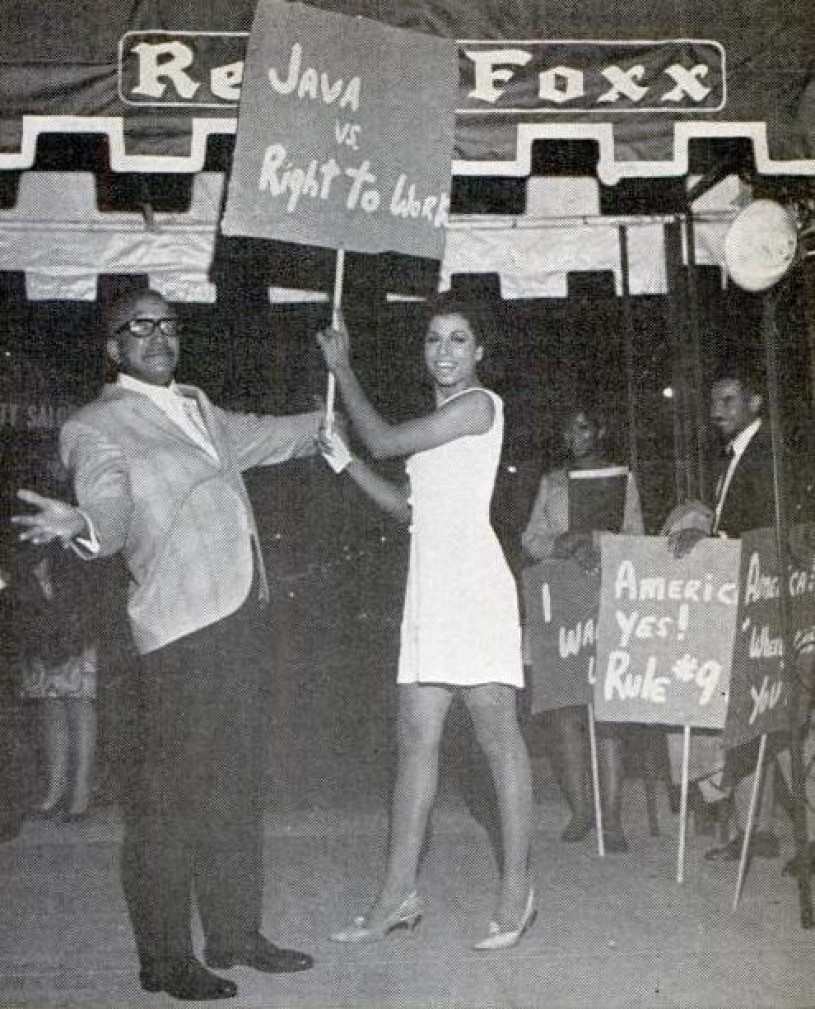
Rather than retreat, she organized.
Standing outside the Redd Foxx Club in a white dress and matching pumps, she held a sign reading “Java vs. Right to Work.” The image captured both the stakes and the strategy. She framed the issue not as spectacle, but as economic discrimination.
With assistance from the American Civil Liberties Union and attorney Jean Martin, Sir Lady Java sued the city, challenging Rule No. 9. It marked one of the earliest legal actions centering on a transgender performer’s right to employment.
The California Supreme Court ultimately declined to hear the case. The justices ruled that only bar or club owners, not performers themselves, had standing to challenge the ordinance. The ACLU was unable to secure a club owner willing to attach their name to the suit, and the case was dismissed on procedural grounds.
The immediate ruling was a setback. The broader implications were not.
Historians have since noted that Sir Lady Java’s challenge laid important groundwork for later employment discrimination cases involving gay, lesbian, and transgender workers. By contesting Rule No. 9, she asserted a principle that would become central to modern civil rights law; the government cannot arbitrarily deny someone the right to earn a living because of who they are.
“It’s got to stop somewhere,” she said years later. “It won’t unless somebody steps forward and takes a stand.”
Two years after her case was dismissed, Rule No. 9 was nullified in a separate lawsuit involving cabaret regulations. The legal foundation that had blocked her career began to crumble.
Sir Lady Java returned to the stage in the 1970s and continued performing into the early 1980s. She remained visible in a city that had once attempted to sideline her.
Recognition came slowly but meaningfully. She is featured in the 2022 book “Legends of Drag.” An archive of her press materials is housed at Harvard University. In 2022, she served as a grand marshal of the LA Pride Parade, a public celebration in the city where she once protested for the right to work.
Sir Lady Java died Nov. 16, 2024, at age 82.

Her story resonates in contemporary debates over drag bans and restrictions on gender expression in public life. While the language surrounding transgender rights has evolved, the core question she raised remains urgent. Who gets to decide whether someone can show up as themselves and earn a living?
Sir Lady Java understood that equality is not granted; it is demanded, often at personal cost. She insisted that employment discrimination dressed up as morality was still discrimination. She challenged a system that presumed authority over her body, art, and livelihood.
Decades before televised drag competitions introduced mainstream audiences to the artistry of gender performance, Sir Lady Java forced Los Angeles to confront its own contradictions. She made clear that civil rights are not abstract ideals. They are lived realities measured in paychecks, permits, and the freedom to take the stage without fear.

 Gaye Magazine
Mar 31
3 mins read
Gaye Magazine
Mar 31
3 mins read

SaintTreyW
Feb 22
4 mins read

SaintTreyW
Feb 12
5 mins read

Gaye Magazine
Feb 8
2 mins read

Gaye Magazine® is part of Gaye Media, Inc.© 2026 Gaye Media, Inc. All Rights Reserved.
