


 SaintTreyW
Sep 25
6 mins read
SaintTreyW
Sep 25
6 mins read

The price of capitulation is climbing.
At least six hospital systems have entered into agreements with the Trump administration to halt or sharply restrict gender-affirming care for transgender minors, collectively forfeiting at least $24.3 million through federal penalties, damages, and commitments to fund detransition-related medical services, according to an investigation by The Advocate.
The publicly reported total may be higher. Some agreements do not disclose every financial term, including the amount hospitals have committed to services for people seeking to detransition.
What is clear is that a federal campaign once framed as an ideological promise has become a costly institutional reality. Major health systems are being pressured to abandon transgender youth, pay the government, and redirect money toward programs favored by an administration that has made attacks on gender-affirming care central to its political agenda.
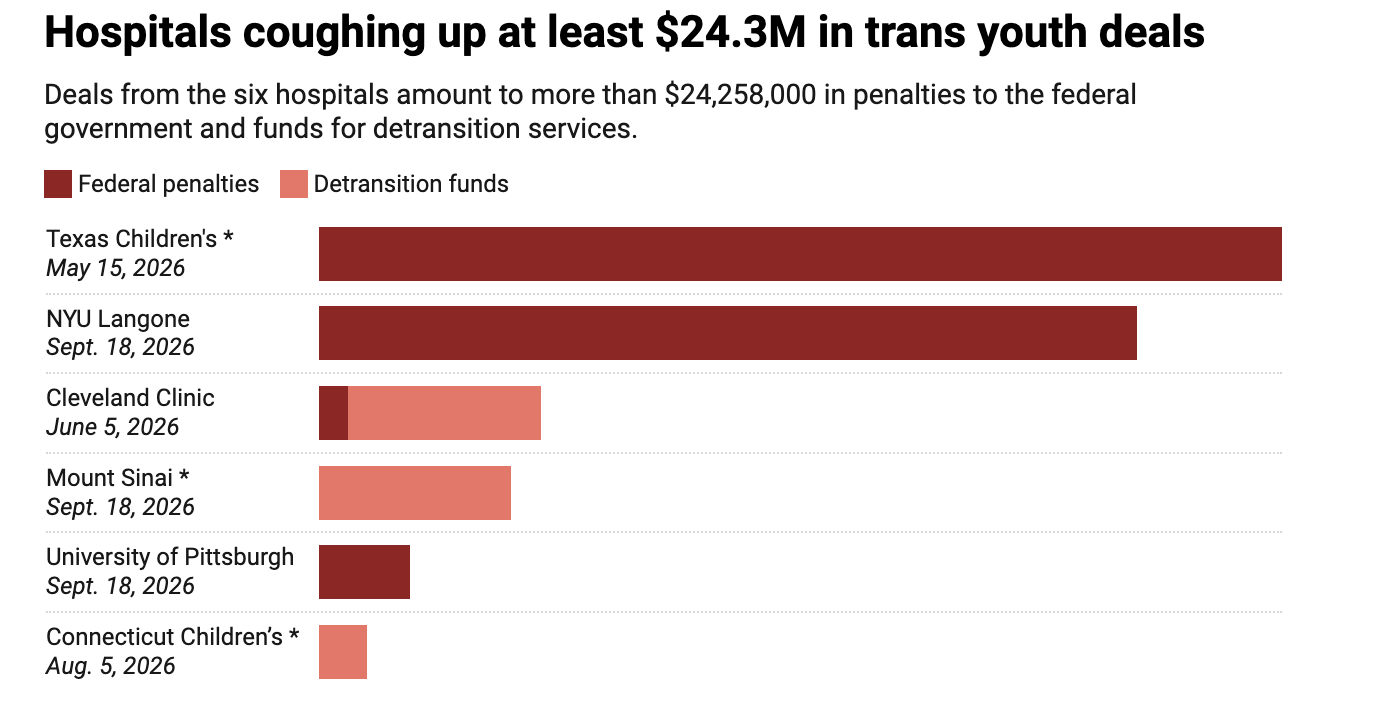
The hospital systems include Texas Children’s Hospital, Cleveland Clinic, Connecticut Children’s Hospital, Mount Sinai Health System, NYU Langone Health, and the University of Pittsburgh Medical Center, or UPMC. The agreements generally require health systems to stop providing some or all gender-affirming medical care to minors, pay monetary penalties and, in several cases, help support services for patients who say they regret prior care. The Advocate reported that the agreements are not admissions of wrongdoing.
The Justice Department has alleged that providers may have violated federal law through improper billing, including the use of false diagnosis codes to obtain insurance payments for care involving transgender youth. Yet its Sept. 18 announcement regarding NYU Langone and UPMC did not publicly detail evidence proving fraud, and both systems expressly denied the allegations. The Justice Department said the claims resolved in those agreements were allegations and that it had not determined liability.
For transgender young people and their families, however, the distinction may offer little comfort. The agreements leave fewer places to seek specialized care and send a chilling message to physicians, therapists and hospital administrators already navigating a politically hostile landscape.
The latest agreements came Sept. 18, when NYU Langone and UPMC reached separate resolutions with the Justice Department.
NYU Langone agreed to pay $8.5 million, while UPMC agreed to pay $950,000, for a combined total of $9.45 million. Both systems agreed to stop providing puberty blockers, hormone therapy, and surgical procedures to patients younger than 18.
The Justice Department said its investigations centered on possible federal-law violations tied to medical billing. But the department’s announcement also used inflammatory language to describe gender-affirming care, adopting the administration’s ideological framing rather than the terminology used by major medical organizations and many clinicians.
NYU Langone and UPMC said they settled to avoid extended litigation and to protect patients, families, providers and sensitive medical information from further disclosure. UPMC said the agreement included privacy, confidentiality and nonprosecution protections and did not include an admission of wrongdoing.
Both systems said care for adults and pediatric mental health services would continue. But advocates say the loss of specialized medical care for minors cannot be dismissed as a narrow administrative change.
“Major health systems are retreating from gender-affirming care for a specific community under the threat of investigations, funding losses, and political retribution, leaving patients and families with fewer places to turn,” Kei Williams, executive director of The New Pride Agenda, told Gothamist.
The settlements did not emerge in isolation. They follow months of federal scrutiny, including investigations, subpoenas and threats involving health systems that provide care to transgender adolescents.
The Trump administration has threatened health care providers with the loss of federal funding tied to programs such as Medicare and Medicaid. The Justice Department has also sought access to patient records and internal communications connected to gender-affirming care programs, a strategy that has alarmed civil liberties advocates and families concerned about medical privacy.
For institutions dependent on federal reimbursements, research funding and the ability to protect confidential records, the risk calculation is immense. A prolonged federal investigation can consume years, drain resources and leave hospitals vulnerable to sweeping document demands.
But LGBTQ+ advocates argue that the hospital systems are being asked to make a moral calculation, too, and that too many are choosing financial preservation over the well-being of transgender patients.
Lambda Legal criticized the agreements as political capitulation, particularly because a federal injunction had already blocked hospitals including NYU Langone and Mount Sinai from releasing patient information in response to federal demands.
“While we don’t know the full terms of the agreement, we do know it is another capitulation that puts political retribution over hospitals’ ethical and legal obligations to, and the well-being of, trans youth,” Lambda Legal said in a Sept. 22 statement.
That criticism goes to the heart of the emerging crisis. The administration’s approach does not merely target a medical treatment. It pressures institutions to decide whether transgender children remain patients deserving of care or liabilities best removed from a balance sheet.
The earlier settlements established the pattern now visible at NYU Langone and UPMC.
Mount Sinai Health System agreed this month to end gender-affirming medical care for minors, pay an undisclosed federal penalty and provide $2 million in free medical services for people claiming harm from childhood transition-related care, according to The Advocate.
Cleveland Clinic, Connecticut Children’s Hospital and Texas Children’s Hospital have also reached agreements with federal authorities amid investigations into their programs for transgender youth. Taken together, the six known agreements have generated at least $24.3 million in penalties and related commitments.
The agreements also direct attention and resources toward detransition care, services for people who decide to stop, reverse or alter aspects of a gender transition. Such care can be medically appropriate for patients who seek it. But advocates say the administration is using the concept selectively, elevating a small but politically useful part of patient experience while treating gender-affirming care itself as presumptively suspect.
That framing erases the fact that health care should be individualized. Patients deserve informed consent, rigorous clinical standards, honest discussions about risks and benefits, and appropriate support whether they continue, pause, or change course in their care.
Gender-affirming care is not one single treatment, and it is not offered casually. Care can include mental health support, family counseling, social transition support, puberty-delaying medication, hormone therapy and, in limited circumstances, other interventions determined by clinicians, patients and guardians.
Major medical groups have supported access to evidence-based gender-affirming care and have emphasized the importance of individualized treatment for transgender and gender-diverse young people. Reporting and medical experts have also noted that access to affirming care is associated with improved mental health outcomes for many transgender youth. Scientific American Columbia University Department of Psychiatry
The administration’s enforcement campaign has effectively narrowed those options, especially for families without the money, time, or ability to travel across state lines for care.
“The continued attack on our community isn’t going to benefit anybody,” Lyndsey Sickler of TransYOUniting said after UPMC’s agreement, according to CBS News Pittsburgh. “It’s going to cost them a lot more than $1 million … but they are not putting that math together.”
That cost cannot be measured solely in settlement totals.
It includes young people forced to interrupt relationships with trusted physicians. It includes parents who must explain why a hospital once presented as a safe place is no longer available. It includes clinicians whose ability to practice evidence-based medicine is being constrained not by new scientific findings, but by political threats and federal pressure.
The $24.3 million figure documents the financial toll of the administration’s campaign. The deeper toll is borne by transgender youth whose access to care is being negotiated away, agreement by agreement.

SaintTreyW
Sep 17
5 mins read

SaintTreyW
Sep 16
7 mins read

 Anders Hare
Sep 1
3 mins read
Anders Hare
Sep 1
3 mins read

Anders Hare
Aug 31
3 mins read

Gaye Magazine® is part of Gaye Media, Inc.© 2026 Gaye Media, Inc. All Rights Reserved.